
Definition At A Glance
A visible answer layer for the term "Quantonomy"
This page intentionally explains the term in plain language before moving into theory, framework, and application.
Direct Answer
What is Quantonomy?
Quantonomy studies the organizing principles and usable resources of the quantum world.
Why it matters
A broader frame for the quantum era
Quantonomy gives students, leaders, engineers, and policymakers a way to talk about the whole quantum ecosystem instead of only the math or the physics.
What it includes
Science, systems, and adoption
- Quantum Fundamentals
- Quantum Physics
- Quantum Mechanics
- Quantum Materials
Why the World Needs It
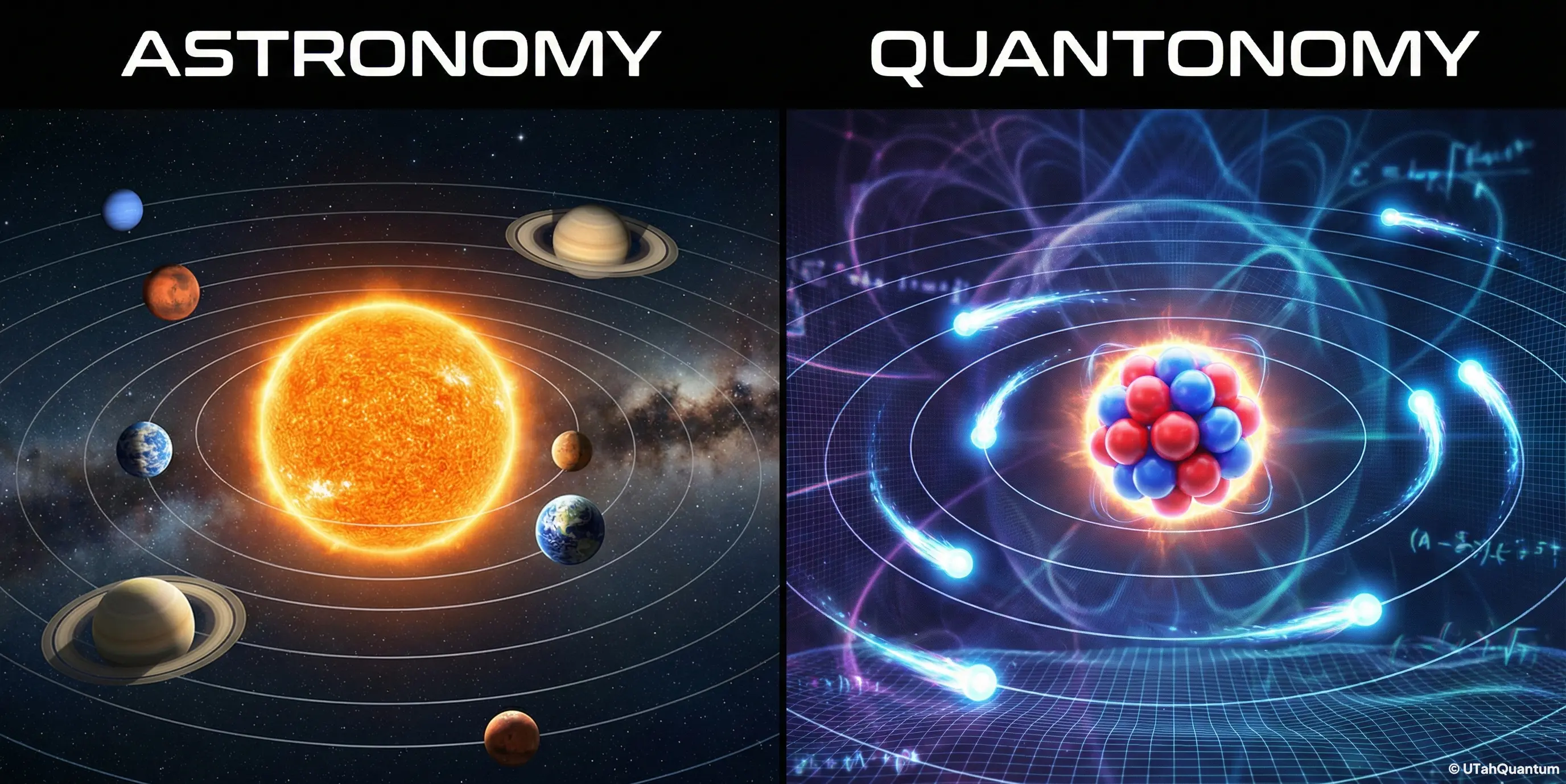
Quantonomy performs the same function for the quantum realm that Astronomy performs for the cosmos: it provides a unified domain for observation, classification, and practical understanding.
Standard Definition
The comprehensive study and classification of quantum entities, phenomena, laws, and systems.
The interdisciplinary field concerning the application of quantum laws to technology, industry, and human advancement.
Distinct from Quantum Mechanics (math rules) and Quantum Physics (natural science), Quantonomy spans the ecosystem of the quantum era.
Academic Definition
Quantonomy is the systematic study of the principles, structures, and resource laws that govern quantum phenomena, unifying theory, information, and applications across physics, chemistry, materials, sensing, and computation.
Short Form
Quantonomy studies the organizing principles and usable resources of the quantum world.
Pillars of Quantonomy
UTQ Vision (QSI)
What Is Quantonomy?
Quantonomy is the umbrella term for the Quantum Era. Just as Astronomy provides a language for studying celestial systems, Quantonomy provides a language for understanding quantum systems as a coherent domain.
We already have Quantum Mechanics for mathematical rules and Quantum Physics for scientific study, but neither fully names the wider landscape of engineering, policy, applications, commercialization, and systems integration. Quantonomy fills that gap.
Why Do We Need It?
Barriers today
Current terminology creates a barrier to entry for students, business leaders, and policymakers.
Terminology gap
Quantum Mechanics sounds heavily mathematical, while Quantum Physics can feel limited to theory and research.
Inviting the world
Quantonomy reframes the conversation around the full ecosystem, making the field easier to enter and discuss.
An engineer building a cooling system for a qubit is engaging in Quantonomy.
A venture capitalist funding a quantum sensor startup is engaging in Quantonomy.
A policymaker shaping encryption standards is dealing with Quantonomy.
How Do We Use It?
In Education
Instead of framing the entry point only as Intro to Quantum Mechanics, Quantonomy allows a broader starting place covering history, core concepts such as superposition and entanglement, and practical future applications.
In Industry
The Global Quantonomy Market is a more complete framing than the Quantum Computing Market because it includes sensing, communication, materials, systems integration, and adjacent enablement.
In Conversation
Old Way
"I'm interested in quantum physics, but not the math."
New Way
"My focus is on Quantonomy: how these systems integrate with our world."